
Key takeaways:
Understanding moving averages:
Moving Averages (MAs) smooth out price action over a set period,
helping traders identify trends by filtering market noise. The main
types, Simple Moving Averages (SMA) and Exponential Moving Averages
(EMA), are used across different markets and are crucial, particularly
for new traders, to identify trend directions.
Trend direction and moving averages:
Prices above a moving average indicate an uptrend, while prices below
suggest a downtrend. The slope of the MA also signals trend momentum.
Effective strategies often involve multiple MAs across different
timeframes and are combined with other indicators for trend
confirmation.
Key moving average signals: The "golden
cross," where a short-term MA crosses above a long-term MA, signals
bullish potential, while the "death cross," the opposite, signals
bearish trends. These crossover points are valuable but lagging, and
should be used alongside other analysis tools.
Effective use of multiple moving averages:
Analysing multiple MAs like the 20-day, 50-day, and 200-day gives a
comprehensive view of trend strength, with wide MA separation indicating
strong trends. Patterns function well across various markets, including
forex and commodities.
Common pitfalls and getting started:
Avoid over-relying on MAs by using them in conjunction with other
market analyses and risk management strategies. Beginners should start
by understanding technical analysis basics and consider their trading
format before applying MAs to their strategy through effective
platforms.
What is a moving average?
A moving average (MA)
is a technical indicator that smooths out price action by calculating
the average closing price over a specified period. This helps traders
filter out market noise and identify the underlying trend direction.
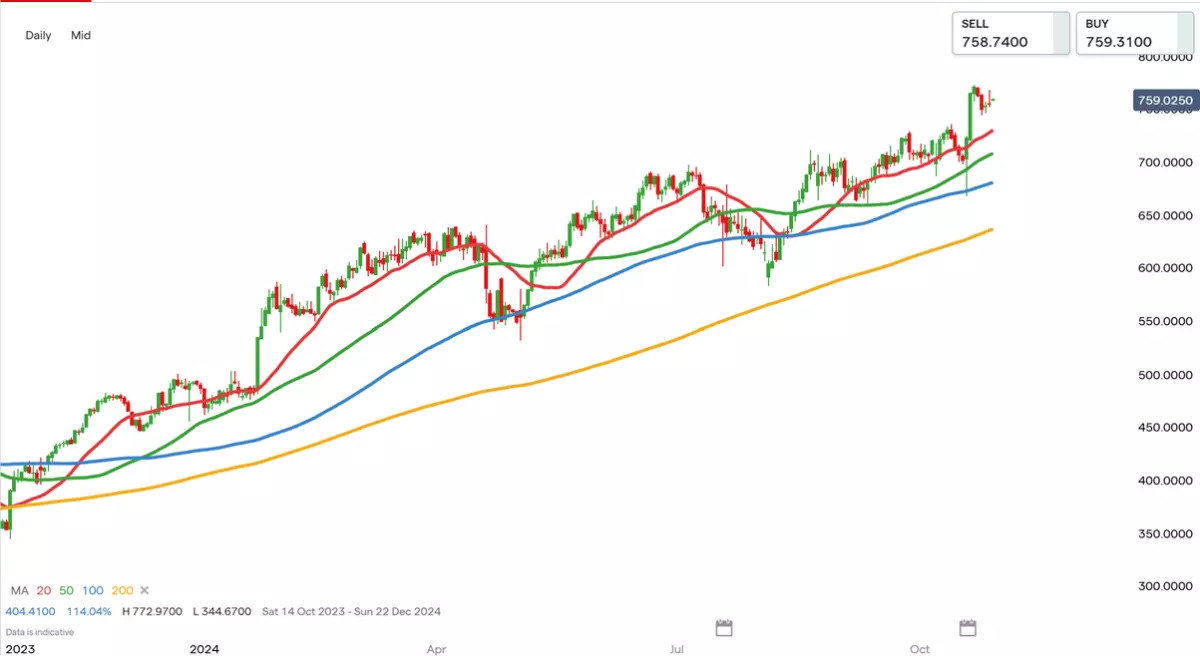
The
most common types are the simple moving average (SMA) and exponential
moving average (EMA). While both serve similar purposes, EMAs give more
weight to recent prices, making them more responsive to current market
conditions.
MAs are versatile tools that can be used across
different markets, whether you're trading forex or shares. They're
particularly useful for newer traders learning to identify trends,
though even experienced traders rely on them as part of their strategy.
How moving averages indicate trend direction
The relationship between price and MAs provides clear signals about trend direction. When prices consistently trade above a MA, it suggests an uptrend is in place.
Conversely, prices trading below a MA typically indicate a downtrend. The slope of the MA itself also provides valuable information – an upward-sloping MA suggests bullish momentum.
Many traders combine MA with other technical indicators to confirm trend signals. This might include momentum indicators or trading signals.
How to get started with moving average trading
1. First, familiarise yourself with the basics of technical analysis and understand how MAs work.
2. Choose whether you want to trade online using spread betting or CFDs, or invest for the longer term.
3. Open an account with us to access our advanced trading platform and comprehensive charting tools.
4. Once your account is set up, you can start applying MAs to your chosen markets and developing your trading strategy.
Remember: MAs are powerful tools for trend identification, but successful trading requires a comprehensive strategy that includes proper risk management and market analysis.

Categories
Articles
News
Investors Digests
Main Courses
News
Strategies
Indicators
Guides
Workbooks
Glossary
Lessons
A Glossary
B Glossary
C Glossary
D Glossary
E Glossary
F Glossary
G Glossary
H Glossary
I Glossary
J Glossary
K Glossary
L Glossary
M Glossary
N Glossary
O Glossary
P Glossary
Q Glossary
R Glossary
S Glossary
T Glossary
U Glossary
V Glossary
W Glossary
X Glossary
Y GLossary
Z GLossary
Recent posts

Zcash
26 Nov 2024
Zilliqa (ZIL)
26 Nov 2024
Yield Curve
26 Nov 2024