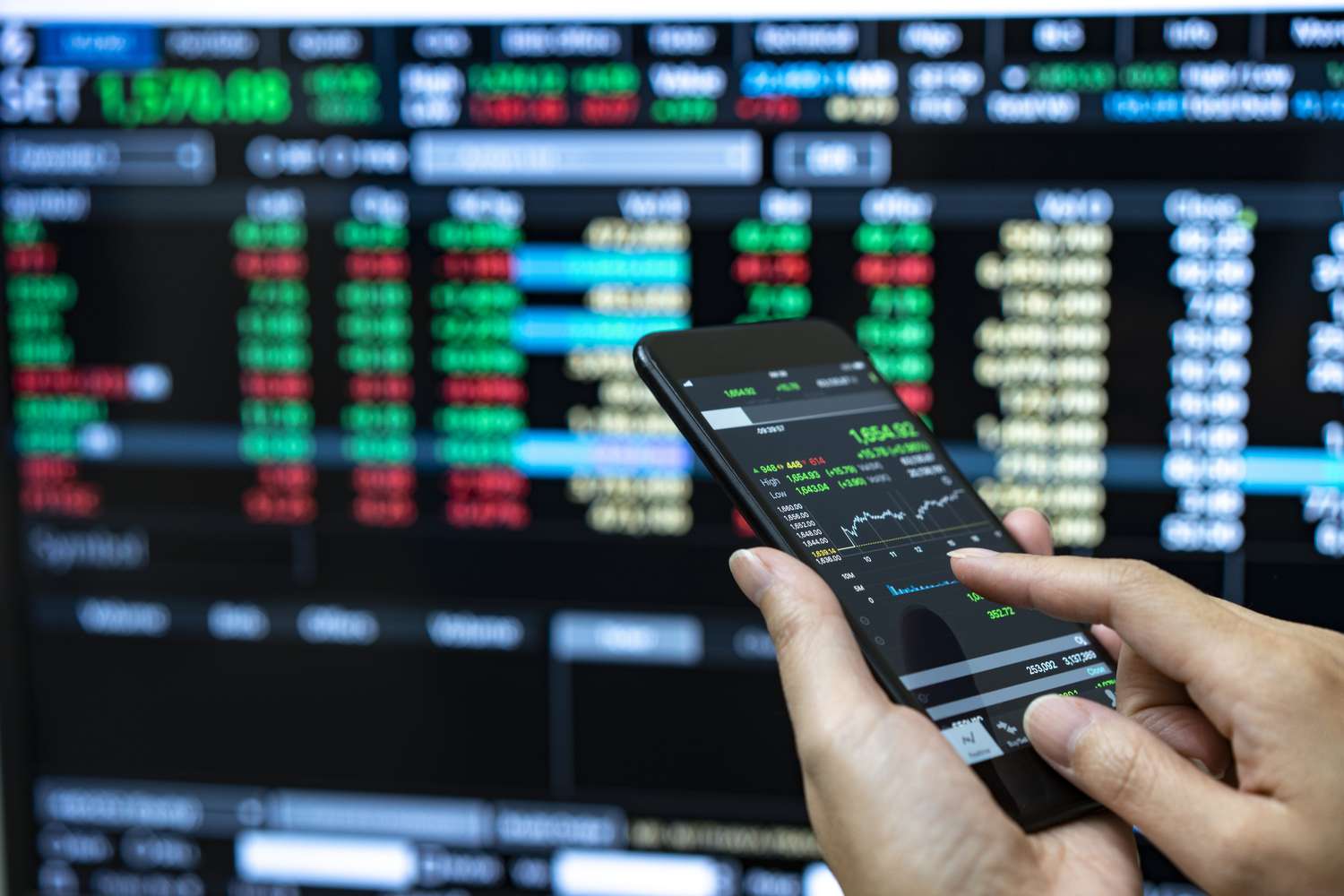
This article will explain in detail all aspects of quantitative analysis and quantitative trading. You will also get acquainted with the terms and consider historical data. Read on to learn how quantitative trading works, what software is used, and what quant trading strategies are most profitable.
What is Quantitative Trading?
Quantitative trading (also called quant trading) involves the use of computer algorithms and software. Quant trading is widely used at individual and institutional levels for high-frequency, algorithmic, arbitrage, and automated trading.
The quantitative trader’s job is to determine the direction of the trend and possible reversal points. It does not matter what tools, strategies, or type of analysis are used, as long as it does the trick. You only need to find reversal points, determine the strength of the trend, and enter the market at its beginning.
A quant trader, unlike ordinary traders, hardly participates in the trading process. Quant trading involves activities related to data science and programming. Simply put, a quantitative trader identifies statistical patterns and price movement patterns of a trading instrument. This data is then used to write software for automated trading.
Major Takeaways:
Quantitative trading relies on automated algorithms and data analysis.
High-frequency trading includes numerous strategies.
Quantitative analysis minimizes calculation errors.
Quantitative trading allows effective asset diversification.
Quantitative strategies work best in highly liquid markets.
History of Quant Trading
In 1973, Fischer Black and Myron Scholes first published the option pricing model formula. The key point in determining the option value was the expected volatility, which can be calculated mathematically.
In 1997, the Black-Scholes model won the Nobel Prize in economics, radically changing the approach to developing trading strategies. Transactions based on mathematical analysis proved highly profitable, and quantitative equity trading was adopted by market makers and investment banks.
Why Use Quantitative Trading?
Quantitative stock trading is considered the next evolution in market analysis, offering:
Scalability: High-frequency trading can include an unlimited number of strategies and inputs.
Unlimited diversification: It allows capital allocation across hundreds of assets, reducing risk.
Minimum error: Statistical analysis reduces calculation errors to near zero.
Decision-making speed: High-performance computing ensures fast trading decisions.
When Quantitative Trading is Needed
Quantitative trading is essential when:
A trader wants to diversify an asset portfolio across hundreds of instruments.
Testing or developing new strategies in less time with extensive statistical analysis is required.
Market Conditions for Quant Strategies
Quant strategies thrive in markets with:
High liquidity
Balanced competition
Extensive historical data
Correlation analysis among trading instruments
Quantitative strategies also perform well in high-risk markets like cryptocurrencies by controlling drawdowns and optimizing capital allocation.
How Does Quantitative Trading Work?
Quantitative trading relies on mathematical analysis and projection models. Here’s how it works:
Select a time interval and data set (e.g., price, drawdowns, high/lows).
Apply algorithmic methods for market research.
Analyze data to make trading decisions.
Quant traders write algorithms using programming languages like Python, MATLAB, or R. These algorithms analyze parameters, find patterns, and forecast trends for automated execution.
Difference Between Quantitative and Traditional Trading
Quantitative trading differs from traditional trading by:
Moving beyond fundamental and technical analysis to focus on statistical patterns.
Using algorithms to evaluate trading opportunities flexibly.
Applying strategies to larger datasets and multiple assets.
Quant and algorithmic trading often work together, especially in arbitrage, which uses algorithms to exploit price differences across platforms.
Examples of Quantitative Trading Success
Medallion Fund: Founded by Jim Simons, this fund uses market-neutral strategies and advanced algorithms.
Two Sigma Investments: Focuses on AI and machine learning for trading.
D.E. Shaw & Co.: Develops sophisticated modeling systems for tracking market anomalies.
Quantitative Trading Systems
A complete quantitative trading system consists of:
Strategy Identification: Finding and analyzing trading methods.
Strategy Backtesting: Testing algorithms on historical data to optimize performance.
Execution Systems: Synchronizing algorithms with trading software for order execution.
Risk Management: Allocating capital and minimizing transaction costs.
Quantitative Trading Strategies
Mean Reversion: Based on the principle that prices revert to average values.
Trend Following: Focuses on making money in rising or falling markets by following trends.
Statistical Arbitrage: Profits from price differences between correlated instruments.
Algorithmic Pattern Recognition: Automates the identification of candlestick patterns.
Behavioral Bias Recognition: Identifies patterns in traders' psychological biases.
ETF Rule Trading: Uses ETFs to implement diversified trading strategies.
Conclusion
Quantitative trading represents the future of market analysis, combining data science, programming, and advanced algorithms to identify profitable opportunities. With its ability to minimize errors, diversify assets, and optimize decision-making, quantitative trading offers significant advantages over traditional methods.
However, successful quant trading requires careful strategy development, backtesting, and risk management. As technology advances, quantitative trading will remain a powerful tool for navigating complex financial markets.

Categories
Articles
News
Investors Digests
Main Courses
News
Strategies
Indicators
Guides
Workbooks
Glossary
Lessons
A Glossary
B Glossary
C Glossary
D Glossary
E Glossary
F Glossary
G Glossary
H Glossary
I Glossary
J Glossary
K Glossary
L Glossary
M Glossary
N Glossary
O Glossary
P Glossary
Q Glossary
R Glossary
S Glossary
T Glossary
U Glossary
V Glossary
W Glossary
X Glossary
Y GLossary
Z GLossary
Recent posts


Zilliqa (ZIL)
26 Nov 2024
Zcash
26 Nov 2024
Yield Curve
26 Nov 2024